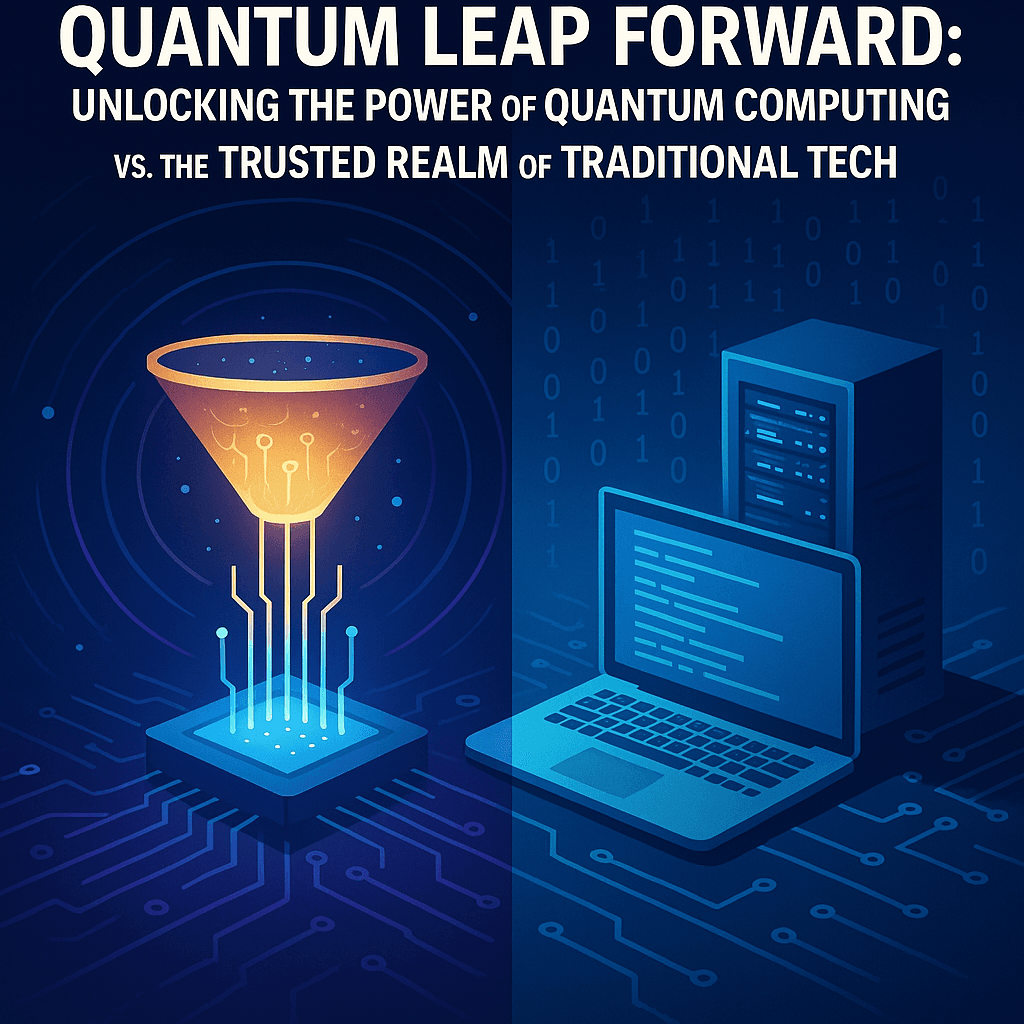
Quantum Leap Forward: Unlocking the Power of Quantum Computing vs. the Trusted Realm of Traditional Tech
Quantum Computing vs Traditional Tech: A Practical Guide to the Future
Engr. Rajib Mazumder is a distinguished ICT expert and visionary storyteller from Bangladesh, boasting over 18 years of experience in technology and innovation. As the Research and Innovation Specialist and Team Lead at the Innovation Design and Entrepreneurship Academy (iDEA), BCC, ICT Division, he spearheads transformative solutions for a tech-driven Future Bangladesh. His pioneering AI research, including projects like "Smart Defence" and "AI Hub," advances national technological ambitions.
Abstract
What if your computer could solve problems in seconds that would take traditional systems millions of years? Welcome to the quantum revolution. This paper serves as a practical guide to quantum computing, exploring its mechanisms, applications, and transformative potential. Through a side-by-side comparison with traditional computing, we unravel how quantum technology leverages qubits and entanglement to redefine computation, while classical systems remain the reliable backbone of our digital world. Keywords: quantum computing, traditional computing, technology impact, quantum advantage.
Introduction to Quantum and Traditional Computing
In the ever-evolving landscape of technology, two titans stand at a crossroads: quantum computing and traditional computing. Traditional computing, built on the binary foundation of bits (0 or 1), has powered humanity’s digital age—from the first calculators to modern smartphones. Meanwhile, quantum computing, with its mysterious qubits capable of existing in multiple states simultaneously, promises to unlock solutions to problems once deemed unsolvable.
Imagine a “digital duel”: the steady, dependable workhorse of classical bits versus the enigmatic, probabilistic quantum qubit. This paper dives into their differences, strengths, and impacts, offering a practical guide for enthusiasts and professionals alike. Keywords: quantum computing basics, traditional computing explained, qubits vs bits.
Core Mechanisms – A Side-by-Side Comparison
To understand the quantum leap forward, we must first explore the engines driving these technologies. Below is a detailed comparison of their core mechanisms:

Table 1: Quantum vs. Traditional Computing Mechanisms
Practical Applications – Where They Shine and Stumble
The true measure of any technology lies in its real-world utility. Here, we explore where quantum and traditional computing excel—and where they falter.
Quantum Computing Applications
• Drug Discovery: Simulates molecular interactions in seconds, accelerating pharmaceutical breakthroughs. • Cryptography: Threatens current encryption (e.g., RSA) by factoring large numbers rapidly. • Optimization: Revolutionizes logistics, from traffic flow to supply chain efficiency.
Quantum computers are cosmic explorers, venturing into uncharted territories of complexity with ease.
Traditional Computing Applications
• Everyday Tasks: Powers word processing, web browsing, and email with unmatched reliability. • Gaming: Drives immersive graphics and real-time rendering. • Data Storage: Ensures stable, accessible archives for the digital age.
Traditional systems are the steady architects, constructing the foundation of our daily digital lives.
This dichotomy paints a vivid picture: quantum computing tackles the extraordinary, while traditional computing anchors the ordinary. Keywords: quantum computing applications, traditional computing uses, quantum technology impact.
The Impact – Revolution vs. Evolution
The rise of quantum computing heralds a revolution, while traditional computing reflects a slower, evolutionary path.
Quantum Impact
• Cybersecurity: Quantum algorithms like Shor’s could dismantle current encryption, necessitating quantum-resistant systems. • Artificial Intelligence: Enhanced processing accelerates machine learning model training. • Industry Transformation: Finance, healthcare, and energy stand to gain from optimized simulations and predictions.
Quantum computing is a game-changer, rewriting the rules of what’s possible.
Traditional Impact
• Gradual Progress: Moore’s Law—the doubling of transistors every two years—is slowing, signaling physical limits. • Digital Backbone: Remains essential for infrastructure, from cloud servers to IoT devices.
Traditional computing is a game-keeper, maintaining stability amid rapid change. Keywords: quantum computing future, traditional computing limits, technology revolution.
Challenges and Roadblocks
No technology is without hurdles. Both quantum and traditional computing face distinct challenges.
Quantum Challenges
• Cost: Building and maintaining quantum systems (e.g., cryogenic cooling) is prohibitively expensive. • Error Correction: Qubits are fragile, prone to decoherence from environmental noise. • Accessibility: Limited to research labs and tech giants like IBM and Google.
Quantum computing is a wild stallion—powerful, yet needing taming.
Traditional Challenges
• Physical Limits: Transistor miniaturization is nearing atomic scales, stalling Moore’s Law. • Energy Demands: High-performance computing consumes vast power, raising sustainability concerns.
Traditional computing is an aging warrior, nearing the end of its evolutionary stride. Keywords: quantum computing challenges, traditional computing drawbacks, future tech hurdles.
The Future – A Symbiotic Dance?
Rather than a rivalry, the future may see quantum and traditional computing in a symbiotic dance. Hybrid systems could emerge, blending quantum’s exponential power with traditional reliability. Imagine a cosmic ballet: quantum pirouettes through complex problems—factoring, optimization, simulations—while traditional computing waltzes through the mundane—databases, interfaces, backups.
Companies like IBM and Microsoft are already exploring this synergy, developing frameworks where quantum processors complement classical CPUs. The result? A harmonious partnership that amplifies human potential. Keywords: quantum computing trends, hybrid computing future, next-gen technology.
Conclusion
Quantum computing isn’t here to replace traditional systems—it’s here to amplify them. As a practical guide, this paper reveals how quantum technology, with its qubit-driven prowess, promises a leap into the future, while traditional computing remains the trusted realm upholding our present. Together, they signal a new era of innovation. Dive deeper into the quantum realm and witness how it’s rewriting the rules of computation. Keywords: quantum computing guide, traditional vs quantum conclusion, tech innovation.
References
1. Nielsen, M. A., & Chuang, I. L. (2010). Quantum Computation and Quantum Information. Cambridge University Press.
2. IBM Quantum. (2023). “The Future of Quantum Computing.” [Online Resource].
3. Arute, F., et al. (2019). “Quantum Supremacy Using a Programmable Superconducting Processor.” Nature, 574(7779), 505-510.
4. Moore, G. E. (1965). “Cramming More Components onto Integrated Circuits.” Electronics Magazine.