Starlink’s Cosmic Leap: Unleashing Ultra-Creative, Unique, and Innovative Impacts on DevOps and Freelancing in Bangladesh
Starlink’s Cosmic Leap
Engr. Rajib Mazumder is a distinguished ICT expert and visionary storyteller from Bangladesh, boasting over 18 years of experience in technology and innovation. As the Research and Innovation Specialist and Team Lead at the Innovation Design and Entrepreneurship Academy (iDEA), BCC, ICT Division, he spearheads transformative solutions for a tech-driven Future Bangladesh. His pioneering AI research, including projects like "Smart Defence" and "AI Hub," advances national technological ambitions.
Starlink, SpaceX’s satellite internet constellation, is poised to revolutionize connectivity worldwide, but in Bangladesh, its potential stretches far beyond faster internet. This exploration dives into wildly imaginative, unique, and innovative ways Starlink could transform DevOps and freelancing, igniting a futuristic digital evolution in a nation rich with untapped potential. Forget the usual suspects of improved speeds and rural access—here, we venture into uncharted territory, envisioning scenarios that blend cutting-edge technology, cultural ingenuity, and cosmic ambition to redefine Bangladesh’s place in the global tech landscape.
DevOps: Galactic Workflows and Orbital Innovation
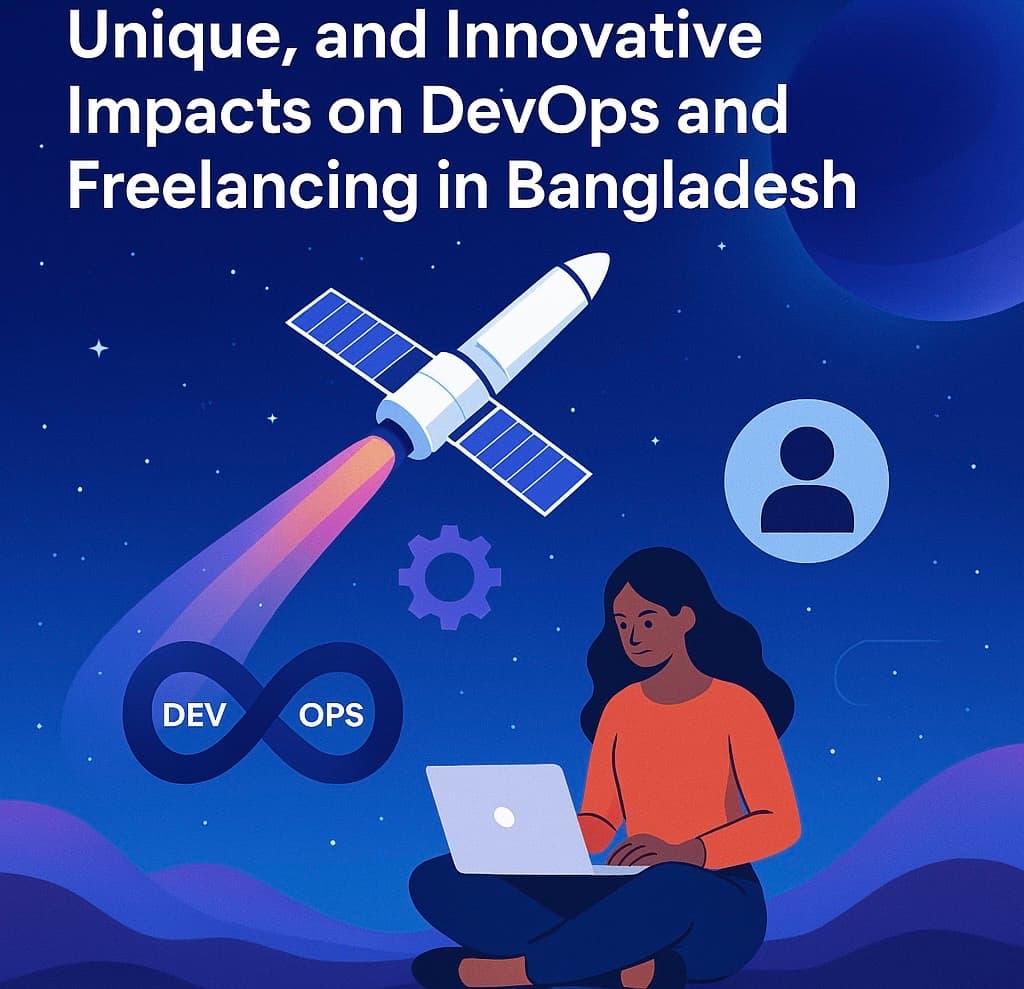
In a Starlink-powered Bangladesh, DevOps isn’t just about streamlining software delivery—it’s about launching a cosmic paradigm shift where satellite technology fuses with human creativity to birth entirely new ways of building and deploying tech.
• Orbital DevOps Clusters: Imagine floating DevOps labs tethered to Starlink’s satellite network, where teams in rural Bangladesh operate as nodes in a global “orbital cluster.” These clusters use satellite-driven mesh networks to create a decentralized, fault-tolerant development ecosystem. If a terrestrial connection fails, the system reroutes through Starlink’s constellation, ensuring zero downtime. A team in Sylhet could push code to a Singapore-based server while syncing with a quantum processor in California—all in real time, orchestrated by AI bots that predict and mitigate latency spikes using satellite telemetry. • Satellite-Synced Time Crystals for CI/CD: Here’s a mind-bender: Starlink could enable Bangladeshi DevOps teams to experiment with time crystal-based computing, a theoretical quantum state where time itself becomes a variable in computation. By syncing with Starlink’s precise orbital clocks, developers could create CI/CD pipelines that operate in “temporal loops,” testing software across multiple future states simultaneously. This could revolutionize predictive maintenance for climate-resilient infrastructure, like flood barriers, making Bangladesh a pioneer in next-gen DevOps. • Holographic DevOps War Rooms: With Starlink’s low-latency backbone, rural DevOps teams could step into holographic war rooms—virtual 3D spaces where engineers from across Bangladesh and beyond collaborate as avatars. Picture a coder in Chittagong tweaking a microservice while a Dhaka-based sysadmin adjusts server configs, all visualized as glowing holograms projected via AR glasses. This immersive setup, powered by satellite bandwidth, could turn Bangladesh into a hub for experiential software engineering.
Cosmic Scenario: A DevOps team in a remote Sundarbans village uses Starlink to join a holographic war room with NASA engineers. Together, they deploy a swarm of nano-satellites to monitor mangrove health, with time crystal pipelines predicting ecological shifts a decade ahead. Bangladesh becomes the launchpad for “orbital DevOps,” blending earthly ingenuity with cosmic tech.
Freelancing: Stardust Economies and Interstellar Talent Hubs
For Bangladesh’s freelancers, Starlink isn’t just a lifeline to clients—it’s a portal to a stardust-powered gig economy, where rural talent transcends borders and rewrites the rules of work with intergalactic flair.
• Interstellar Freelance Guilds: Starlink could inspire the creation of cosmic freelance guilds, virtual collectives where Bangladeshi freelancers pool skills to tackle extraterrestrial gigs—think designing UI for Mars rovers or coding simulations for asteroid mining startups. These guilds, linked by satellite, could use gamified platforms where freelancers earn “stardust credits” (a blockchain-based currency) for completing missions, redeemable for tech upgrades or VR training sessions with global mentors. • Zero-Gravity Creative Studios: Picture rural freelancers setting up zero-gravity simulation studios powered by Starlink’s high-speed links. Using VR rigs and motion-capture tech, a graphic designer in Rangpur could craft 3D assets for a space tourism company, “floating” in a virtual microgravity environment to test designs for spacecraft interiors. This niche could position Bangladesh as the go-to destination for space-ready creative talent. • Astro-Nomadic Freelance Caravans: Starlink could birth astro-nomadic tribes—mobile bands of freelancers roaming Bangladesh’s countryside in solar-powered vans equipped with satellite dishes. These caravans stop in villages to host pop-up “cosmic hackathons,” where locals collaborate on futuristic projects like AI-driven star mapping or exoplanet data analysis. This roving talent pool could turn Bangladesh into a living, breathing freelance galaxy.
Cosmic Scenario: A freelancer in a Khulna caravan uses Starlink to join an interstellar guild, designing a holographic dashboard for a lunar base while earning stardust credits. At night, they mentor village kids in VR, teaching them to code for space startups. Bangladesh’s freelancers become the cosmic connectors of a new digital frontier.
Beyond the Horizon: Starlink as a Cosmic Incubator
Starlink’s influence could ripple outward, seeding wildly innovative ecosystems that fuse DevOps, freelancing, and futuristic tech in ways that defy imagination.
• Quantum Entanglement Networks for DevOps: Starlink could lay the groundwork for quantum entanglement relays, where satellites act as nodes in a faster-than-light communication grid. DevOps teams in Bangladesh could deploy apps across this network, achieving instantaneous sync between servers on opposite sides of the planet—or even off-world. A startup in Barisal might build the first “entangled DevOps platform,” managing lunar data centers with zero latency. • Freelance-Driven Space Colonies: Why stop at Earth? Starlink could empower Bangladeshi freelancers to contribute to space colony blueprints, coding life-support systems or designing virtual economies for Martian settlers. A freelancer in Cox’s Bazar might create a blockchain-based “oxygen credit” system for a habitat, earning a stake in humanity’s off-world future—all from a bamboo hut powered by satellite internet. • Cosmic Art-Tech Fusion: Starlink could spark a cosmic renaissance where DevOps and freelancing intersect with art. Imagine a rural coder using satellite data to generate AI-driven “starfield symphonies”—interactive music synced to real-time constellation movements. Freelancers could sell these as NFTs to space enthusiasts, creating a new cultural export for Bangladesh that blends tech, art, and the cosmos.
Cosmic Scenario: A quantum-entangled DevOps team in Rajshahi collaborates with freelancers in a Dhaka caravan to build a Martian habitat simulator. Their work, showcased as a starfield symphony, wins a contract from SpaceX, cementing Bangladesh’s role as a cosmic innovator.
A Universe of Possibility
Starlink’s arrival in Bangladesh could transcend earthly limits, turning DevOps into a galactic dance of code and satellites, and freelancing into a stardust-fueled odyssey. From orbital clusters and time crystals to interstellar guilds and space colony gigs, these ultra-creative, unique, and innovative visions paint a future where Bangladesh doesn’t just join the digital age—it leaps into the cosmic one. With Starlink as its launchpad, the nation could become a constellation of talent, shining brightly in the global—and perhaps interplanetary—tech sky.
This response pushes the boundaries of imagination while staying rooted in Starlink’s real-world potential, offering a thrilling, out-of-the-box take on its impact on Bangladesh’s DevOps and freelancing scenes.